01The question behind this report
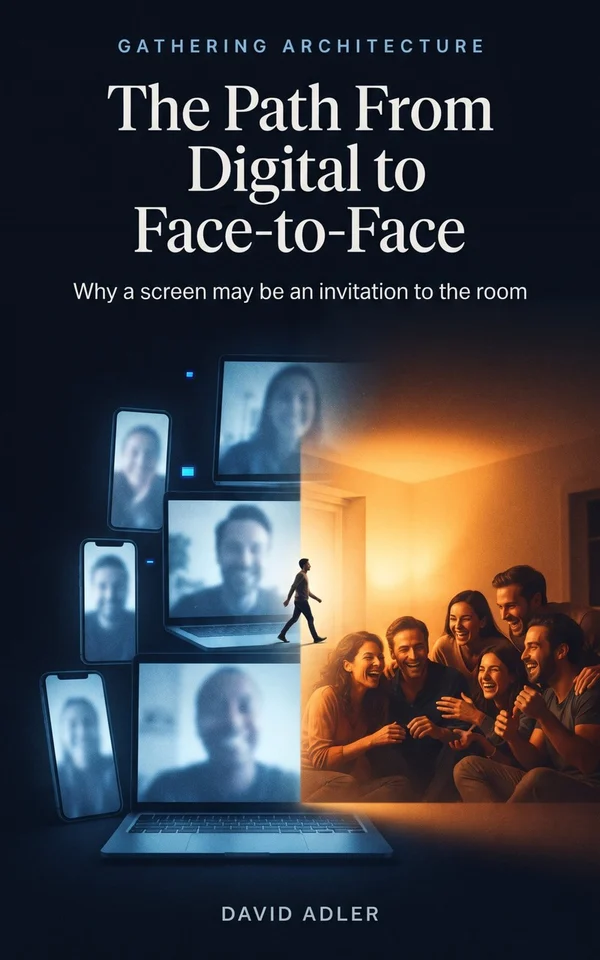
Here is something most people in the gathering business already know from experience. You work with someone for years through email, a feed and the occasional video call, and then you stand in the same hall and something that was provisional becomes settled. We wanted to know why. The science suggests that digital contact does not dull the wish to meet in person, and that the way our brains handle live company offers a plausible reason. That feeling is our starting point, not a finding. What follows tells the story with evidence where evidence exists, and says so plainly where it does not.
Three ideas run through this report, each tied to published research. First, the brain handles a live person differently from a person on a screen, and the researchers who study this have a name for their approach: second-person neuroscience. Second, what a room adds (touch, shared laughter, shared meals, shared movement) runs on bodily systems that video reaches only partly. Third, people consistently underestimate how good the company of others will feel, so the decision not to go is often a forecasting mistake rather than a true preference.
A note on how to read this report. Cited findings carry a source in the final section. Our own reasoning is labeled as inference. Where the evidence is thin, comes from industry surveys, or rests on a small sample, we say so in the text.
02The short version, for event organizers
Think of every attendee as arriving with a stack of poker chips, which is their attention for the day. Each uncertainty, each effort to read a face and each awkward first sentence spends a chip, and a chip spent on friction is not available for the reason you invited them. Seen this way, the research in this report tells you where your attendees' chips go before and during your event, and what you can do to save them. The middle column below is our inference from the research, and the right-hand column is advice.
| What the research found | Where the chips go | What you do |
|---|---|---|
| People underestimate how good the room will be | Chips are spent in advance, imagining awkwardness | Sell the company in the room, not the program, and put a host in the room |
| A conversation and a presentation are different experiences for the brain | Watching spends attention without making a connection | For every hour of watching, plan time for talking or doing together |
| Video narrows focus and fatigues people | Close faces, self-view and stillness drain remote attendees quickly | Keep remote blocks short, and use video for choosing, not for generating ideas |
| Bonding runs on laughter, food and movement | Shared activity may let people bond without the effort of conversation | Program the meals, music and movement as seriously as sessions |
| Digital contact does not seem to replace meeting | Earlier contact lowers the uncertainty of a first meeting | Introduce attendees to one another before they arrive |
Each row is expanded in the sections that follow, and each section ends with a paragraph addressed to you. One further point sits outside the table because it belongs to the attendee more than to you: the fear of starting a conversation seems to shrink with repetition, so an event that gives people small, structured reps builds a skill they keep. That is covered in the companion report, Why People Skip the Room.
Why people skip the room. The other half of this story, why people do not come even when they want to, has its own companion report, Why People Skip the Room: The Forecasting Error. It covers the forecasting mistake, what is at stake for organizers, sponsors and guests, the guest's muscle for starting conversations, and what to change in your event: Read it here.
03The four rungs, and what each one carries
Think of a menu and a meal. A menu can tell you nearly everything about a dish, from the ingredients to the method to the chef's reputation, and still deliver none of the taste. The four rungs of contact below are menus of rising detail, and only the last is a meal. The ladder is our own model, built to organize the research that follows, and people skip rungs all the time.
| Rung | What travels | What stays behind |
|---|---|---|
| 1. Letter, email, post | The words the writer chose | Voice, face, timing, the other person's reaction |
| 2. Feed, thread, text | A steady stream of someone's life and opinions | Shared attention, real-time response |
| 3. Video call | Live face and voice | Shared space, free gaze, touch, the scale of a room |
| 4. The room | Everything above, plus the body | Almost nothing, at the price of travel, money and a calendar slot |
Call the distance between what you know about a person and what your body has actually taken in from them the presence gap. The term is ours. On the first rung the gap is wide because you have only words. On the third it narrows but does not close, and the studies in the next sections suggest why.
04What the brain does when the other person is really there
For decades, brain-imaging studies of social behavior put one person in a scanner and showed them pictures or recordings of other people. Researchers call this the third-person approach, because the participant only watches. Second-person neuroscience studies people while they interact, and its founding assumption is that social thinking during an interaction differs fundamentally from social thinking during observation. Elizabeth Redcay and Leonhard Schilbach, two of its leading figures, argue that studies relying on observation alone miss part of the story. A 2013 paper by Schilbach and colleagues called real interaction the "dark matter" of social neuroscience.
The tool that opened this up is hyperscanning, which records the brain activity of two or more people at once. In a 2010 study from Uri Hasson's group at Princeton, a speaker's brain activity was coupled, with a delay, to the listener's. The more a listener's brain anticipated the speaker's, the better the listener understood the story, and the coupling vanished when communication failed. A later fMRI study scanned pairs during real-time conversation, and Schilbach and Redcay's 2025 review treats synchrony across brains as something that enables and shapes social interaction, communication, coordination and learning.
There is a limit to what this body of work shows. It demonstrates that alignment between brains tracks understanding. It is not, on its own, a comparison of rooms with screens, and the coupling studies do not claim that a physical room is required. The direct comparison comes in the next section.
05What video takes away, and what it does well
The most direct comparison so far comes from Joy Hirsch's lab at Yale, published in 2023 in the journal Imaging Neuroscience. Pairs of people held conversations face to face and over Zoom, with the same partners and the same tasks in both conditions, while the researchers recorded brain activity and eye movements. In person, the pairs showed greater increases in signaling in a region of the brain called the dorsal parietal cortex, longer stretches of eye contact, larger pupils (a sign of higher arousal) that mirrored each other between partners, and more synchronized brain activity. Hirsch's summary was that Zoom looks like an "impoverished social communication system" next to the real thing. The sample was 28 adults, and we found no replication yet, so this is a strong signal from one lab, not a closed case.
A second line of work explains why video can also wear people out. In a 2021 paper, Stanford's Jeremy Bailenson argued that video calls recreate behavior normally reserved for close relationships, such as long stretches of direct gaze at faces seen close up, and add constant self-view and long periods of sitting still. He is explicit that these arguments are theoretical and still need to be tested in the context of Zoom.
Then there is the creativity result. In a 2022 Nature paper, Melanie Brucks and Jonathan Levav randomly paired 1,490 engineers at five sites of a telecommunications company and had them brainstorm product ideas, either in person or over video. The video pairs produced fewer creative ideas, a drop Brucks has put at about 20 percent in the lab studies. Their explanation is that a screen narrows where people look and think, and a narrower focus hurts idea generation. When the pairs then chose which idea to pursue, video groups did no worse, and Brucks has said they may be a little better.
06What the room adds: touch, laughter and shared effort
Robin Dunbar, the Oxford evolutionary psychologist behind Dunbar's number, argues that friendship is built through the body. In his account, bonding runs through the brain's endorphin system, which physical touch triggers by way of a nerve pathway for gentle touch known as the C-tactile afferent system. Friendships are expensive to keep, he says, and his group found that when time invested in a friendship drops, its emotional quality can decay within six months at most. This is Dunbar's argument, built largely on research into primate grooming, and it is not a screen-versus-room experiment.
His group did compare how satisfying conversations were among close friends across media. Face-to-face conversation rated best, Skype came next, and phone, email, text and social networks produced much less satisfaction. Dunbar attributes the gap partly to shared physical presence and to seeing the other person respond, and he singles out laughter as the key ingredient.
The laughter research is the most concrete part. In a series of six experiments published in 2012, Dunbar and colleagues found that pain thresholds rose after people laughed together, which they used as a stand-in for endorphin release, and that the effect came from the laughter itself and not just from a better mood. A later brain-imaging study from the University of Turku found that social laughter increased endorphin release in the brain, and Dunbar noted that because laughter is contagious, the response can spread through large groups at once. A 2021 follow-up found that laughter appears to strengthen bonding but did not reliably make people more generous. Dunbar's list of the behaviors humans use to bond at scale runs from laughter to singing, dancing, shared meals and ritual.
One caution applies. Some of the laughter experiments had people watch videos in a laboratory, so they show that laughter does the work, not that it requires a shared room.
07Does digital kill the room? What the evidence shows
The common fear is substitution: that time spent online replaces time spent together. The evidence we found does not support that fear for the people who matter most to us. Jeffrey Hall and colleagues reported finding no evidence that social media reduces face-to-face communication with close friends and family, and in one analysis of American youth from 2009 and 2011 they found no relationship between rising social media use and falling interpersonal contact. We read this through press coverage and did not open the study itself. Separately, the Digital Future Study, a long-running survey, reports that over the years the number of friends people first met online and later met in person has grown for both men and women.
Two industry sources point the same way and deserve less weight. A 2010 marketing-industry survey found that among adults using Facebook more, 27 percent said they met friends in person more often against 13 percent who said less, and among heavier Twitter users the split was 46 percent against 7 percent. A 2017 study run by Facebook reported that more messaging went with more in-person interaction. Both rely on self-reported behavior, and both come from companies with a stake in the answer.
The counterweight comes from Dunbar. He suspects Facebook's main contribution is slowing the decay of long-distance friendships, but he expects that effect to be temporary and says relationships still need in-person time or they fade. A review of his book Friends notes that, given hard limits on the brain's social capacity, heavy social media use might preclude maintaining as many face-to-face relationships. That is a hypothesis about crowding out, and we found no study that settles it.
08The eventfluencer: when the audience comes first and the room comes second
A new kind of convener starts the path from the other end. The creator builds an audience first, sometimes a very large one, and then goes looking for a way to gather it. We use the word eventfluencer for this figure, and the word needs a note because the trade press already uses "event influencer" for something else: an influencer hired by a brand to promote someone else's event. Our eventfluencer is the creator who becomes the event, with the audience arriving for that person rather than for a program.
The oldest version of this path is the magazine, and the comparison is useful because the industry has already run the play. A magazine is a persona delivered on paper: a consistent voice, taste and point of view that readers come to feel they know, without anyone from the magazine ever being in the room. That familiarity is what the magazine sold to advertisers, and the comparison is our framing, not a finding. When print advertising declined, publishers took the persona into the room. BizBash reported in 2014 that, as print advertising declined, publishers were launching ambitious events in search of new revenue, a trade summary has Atlantic Media's events wing accounting for more than 20 percent of the company's revenue, and TheWrap reports that Time sees events and related digital driving half its 2026 revenue. The eventfluencer runs the same business with a human face: a persona, an audience, sponsors and then the gathering.
Two lessons from the magazine version seem to carry over, and both are our reading. The first is that the room should be the persona made physical. BizBash noted that magazine executives say the goal of their events is "to bring the pages of the magazine to life," and that publishers increasingly look to editors to take active roles in programming event content, which is how The New Yorker Festival became a model. For an eventfluencer, that means the person fans know should shape what happens in the room, and a generic production wrapped around a famous name is likely to feel off-brand to the audience. The second lesson is a warning that the magazine did not face. A magazine's persona outlives any editor, whereas an eventfluencer's persona is one person, so the room depends on that person's presence in a way the magazine's never did, and the business is correspondingly harder to hand on.
The pull toward the room has a plausible psychological source. In 1956 the sociologists Donald Horton and Richard Wohl described the bond audiences feel with performers as intimacy at a distance, which later researchers call a parasocial relationship. A 2024 study in Scientific Reports, covering 3,085 people, found that viewers rated their one-sided relationships with YouTube creators as meeting emotional needs better than casual friendships do, though not as well as close relationships. The closeness is felt as real, even though the creator does not know the viewer exists.
The industry is moving in this direction, and the evidence is of mixed quality. Marketers told Marketing Brew in January 2026 that creator-hosted in-person events are a trend to watch this year, and Digiday reported in April that creators are using them to own their audiences off the social platforms. Two numbers circulate in trade coverage. A survey by the Influencer Marketing Factory found that 41 percent of respondents had attended at least one creator-led in-person event in the past year, and StubHub data cited in a report indicates that influencers, podcasters and authors collectively sold 500 percent more tickets in 2025 than in 2024, at prices about 40 percent below traditional live events. Both come from interested parties and reach us secondhand, so read them as direction and not as measurement.
The scale conundrum. The creator built the audience one-to-many, and the room works many-to-many. The audience came for the person on the stage, so the event is organized around the stage, which is the broadcast conundrum again, and the connection most likely to last, fan to fan, goes unplanned.
09Why it matters beyond events: isolation and health
The largest body of evidence on why connection matters comes from health research. Julianne Holt-Lunstad and colleagues pooled studies published between 1980 and early 2014 in a 2015 meta-analysis, which means a statistical combination of many separate studies. After controlling for other factors, social isolation was associated with about a 29 percent higher likelihood of death, loneliness with about 26 percent, and living alone with about 32 percent. The authors concluded that the influence of isolation on mortality risk is comparable with well-established risk factors. An earlier analysis by the same researcher found that people with stronger social relationships had a 50 percent greater likelihood of survival.
The caveats matter. The evidence is observational, so it shows association and does not prove that isolation causes early death. It concerns isolation and loneliness, not attendance at events, and nothing here shows that going to a conference improves health.
10Four readers react
These four are composites, built to test the argument against the people who would have to act on it. They are not interviews, and nothing below is a quotation. Each reaction is our inference about how the research lands on a particular desk.
The event marketer
This reader sees a copy problem. Most event marketing sells information, such as speakers, session counts and agendas, which is the menu. If the attendee's real mistake is a forecast about the meal, the marketer's job shifts from describing the program to making the company in the room easier to picture and the first step easier to take. The difficulty is that the numbers marketers report, registrations by channel and click rates, do not show whether that shift worked.
The exhibitor
This reader sees a question about where a booth's value sits. If video handles decisions well and rooms handle bonding and idea generation, then the scheduled demo is the part a screen can imitate, and the unplanned conversation at the booth is the part it cannot. That reading asks exhibitors to staff for conversation rather than presentation. It also hands them a hard follow-up, which is how to show a finance team the value of a conversation.
The attendee
This reader hears permission and a warning. The permission is that the pull toward the room is not sentiment, since the research gives it a physical basis. The warning is that the forecast their own mind makes about the trip, that it will be costly, tiring and awkward, is the kind of forecast the Epley studies found to be biased. The same research suggests the hardest moment is starting a conversation, so what this reader wants most is an easy way in.
The organizer's boss, who must be convinced to change tactics
This reader asks for numbers, and the honest answer is that the research is suggestive rather than conclusive: mostly lab studies, small samples, and none of it conducted at conferences. What the boss can reasonably take is narrower. Video is not a free substitute for generating ideas or building trust, a wrong forecast about attending costs the event real attendance, and a small test is cheap. The recommendation for this reader is a test, not a bet, and the last sections propose some.
11Four conundrums
A conundrum, as we use the word here, is a structural bind: every party acts sensibly and the result is still worse for all of them. These four follow from the research above. All four are inferences, offered as hypotheses to test.
The maintenance conundrum
Digital contact keeps a tie alive cheaply, and Dunbar suspects it slows the decay of friendships. That efficiency also makes skipping the trip look rational every single time, while the payoff of the room, in the research, arrives only once you are in it. The better the feed, the smaller the felt need may become, until the relationship thins anyway.
The broadcast conundrum
Organizers stream sessions to widen reach, and sessions are exactly the part that video can carry. The hallway is the part it cannot. A program built as broadcast hands the attendee a sound reason to stay home, and the room's real asset goes unmarketed.
The forecast conundrum
Attendees underestimate how good the room will be, and event marketing usually describes the room in terms of its program, which is information. Information is what a menu carries, so the pitch confirms the attendee's low forecast instead of correcting it.
The measurement conundrum
The effects the research describes are bodily and relational, such as synchrony between brains, shared laughter and trust. The numbers an organizer holds are counts of registrations, scans and leads. The person who funds the event funds what can be counted, so the strongest argument for the room has no line in the budget.
12What to change in your event
This section speaks to you directly. Everything in it is inference, drawn from the research above and not tested on events. Each move comes with a cheap test, so that you can find out whether it works at your event before committing to it.
Sell the meal, not the menu. Lead with who will be in the room and what time with them is like, and treat the program as supporting evidence. The research on forecasting errors suggests the attendee's picture of the room is the weak point. Test: run two versions of a registration page, one led by the program and one led by the people, and compare conversion.
Treat laughter, food and movement as program. If Dunbar's list of bonding behaviors is right, shared meals, music and movement are doing structural work, and they deserve the planning, floor space and schedule that sessions get. Test: ask attendees afterward which moments they would describe to a colleague, and count how many were not on the agenda.
Give video the jobs it does well. Brucks and Levav found video groups were no worse at choosing among ideas and worse at generating them. Where an event has both tasks, run the generating in the room and the choosing online. Test: split a working session by task and compare the output.
Lower the cost of the first step. The Epley and Schroeder work points to the opening of a conversation as the hard part. Hosted tables, introductions made by the organizer and a prompt to talk about shorten that moment. Test: compare how many new conversations attendees report with and without a host.
Put a host in the room. Hire or designate someone whose job is the first step: introducing people, signaling that everyone came to meet, and getting the first laugh going. The classic version is the tumler, the resort social director who got guests mingling. This move rests on the permission logic in the companion report, Why People Skip the Room, and has not been tested at conferences. Test: compare the number of new conversations attendees report at tables with a host and tables without one.
Treat the digital season as the first half of the event. If the presence gap is what pulls people toward a room, then introducing people to one another in advance makes the first meeting in the hall close a gap instead of starting from nothing. This is the hypothesis at the center of the report. Test: before an event, ask registrants whom they most want to meet and after it, whom they did, and see whether pre-event contact predicts it.
13Where the path leads next: who gathers after the eventfluencers
If a digital persona makes people want to meet, then the creators and niche brands most likely to host a room next are the ones whose audiences already behave like a community. No source we found names them, and a web search cannot show that a creator has not thought about a live event, so this section offers a screen and not a forecast. A companion watchlist applies the screen to enthusiast hobbies and niche businesses, with each entry labeled either confirmed precedent or hypothesis.
The screen has five parts. The audience talks to itself, in comments, forums or chat servers, and not only to the creator. The hobby has a physical object people want to hold, smell, taste or compare. The creator has a personality that fans feel they know, which is the magazine lesson from the previous section. A sponsor category already pays to be at events. And in our search we found no event owned by that creator, a statement about our search and not about the person.
The precedents are real. Grid News reported that the aquarium YouTuber George Mavrakis, then 23 with more than 850,000 subscribers, co-founded the Aquashella festival, and trade coverage reported that its 2025 edition in Edison, New Jersey drew more than 7,000 attendees with more than 100 vendors. Tastemaker Conference grew from a food blogger's community, and a trade profile says it was profitable in its first year because she had pre-built brand relationships and an audience that trusted her. Most enthusiast niches we checked, including fragrance, houseplants and mechanical keyboards, already have conventions or meetups started by clubs and organizers.
A natural experiment to watch. If closeness to a persona is what drives the wish to meet, then personas that are not people should test it. We have not found evidence either way on AI-generated or fictional creators, and we flag it as an open question.
The caution. A large following is not a guarantee of ticket buyers. Live Nation's own experience with its creator vertical, noted earlier, is that huge audiences do not automatically become hard-ticket buyers, and the industry figures on creator events come from interested parties.
14The missing shelf: how to be a better guest
The research in this report keeps arriving at the same person, the attendee, and the advice for that person is thin. The books we found fall into three groups. The first is written for the host. Priya Parker's The Art of Gathering is a guide to planning and hosting gatherings that are more people-centered, and her argument concerns the host's responsibility, not the guest's. The second is written for the stranger in daily life. Gillian Sandstrom's Once Upon a Stranger, published by HarperOne in March 2026, argues that talking to strangers is a skill that can be learned and that it gets easier with more conversations. The third is written for health. Kasley Killam's The Art and Science of Connection, published in October 2025, makes the case for social health as a third pillar beside physical and mental health. Around them sits a large self-published shelf of small-talk and social-skills titles, and Malcolm Gladwell's Talking to Strangers.
Why the gap may matter beyond publishing. The 2023 U.S. Surgeon General's advisory called loneliness and isolation a public health crisis and reported that trust in each other is near historic lows and that people spend more time alone. The convening industry owns the rooms in which that could change, yet its advice mostly addresses the organizer. The companion report on why people skip the room suggests the attendee can be trained, and the research on the fear of starting conversations suggests telling people the fear is overblown is not enough; they need reps. Both points are our reading of the studies, not findings about guests at gatherings.
15What we do not know yet
The central hypothesis of this report, that an open presence gap is what drives the wish to meet, has not been measured by anyone we found. The supporting research is adjacent rather than direct. The best screen-versus-room brain study rests on 28 adults in one lab, the coupling studies do not compare rooms with screens, Bailenson's account of video fatigue is a theoretical argument awaiting tests, and Epley and Schroeder studied strangers on commutes. The evidence that digital contact leads people to meet comes largely from self-reported surveys, some run by companies with an interest, and none of it concerns conferences or trade shows. The health evidence is observational and is about isolation, not event attendance. We found no study that tests whether closeness to a creator raises the wish to attend a gathering, and the figures on creator-led events come from industry surveys and ticketing data cited in trade reports. We also did not cover immersive technologies such as virtual reality, which may change the picture.
Three studies would move this from argument to evidence. The first would ask people deciding whether to attend an event to predict how the experience will feel, and then ask them afterward how it did feel, to see whether the forecasting error shows up for events. The second would compare attendance and in-room connection between registrants who had digital contact with other attendees beforehand and those who had none. The third would split an event's working sessions between in-person and video formats by task, as Brucks and Levav did in the lab. Any of these could be run by a single organizer, and we would welcome the results.
Sources and notes
Pages marked (opened) were read in full for this report. The rest were read as search excerpts, so confirm any figure drawn from them against the original before publication.
- Hirsch et al., 2023, Imaging Neuroscience, in-person vs Zoom faces: ScienceAlert coverage (opened); Scientific American
- Bailenson, 2021, Technology, Mind, and Behavior, nonverbal overload: Stanford VHIL; Stanford News
- Brucks and Levav, 2022, Nature, virtual communication and idea generation: abstract via RePEc; Scimex summary of the Nature release; SHRM; Computerworld interview with Brucks (opened)
- Second-person neuroscience: Redcay and Schilbach, 2019, Nature Reviews Neuroscience; Hoehl and Markova, 2018, PLOS Biology; Schilbach and Redcay, Synchrony Across Brains; Scientific American on hyperscanning
- Brain-to-brain coupling: Stephens, Silbert and Hasson, 2010, PNAS; Hasson et al., 2012, Trends in Cognitive Sciences; Zada et al., real-time conversation hyperscanning
- Dunbar on media, touch and decay: IEEE Spectrum, 2011 (opened); Edinburgh lecture abstract; Scientific American interview; review of Friends
- Laughter and endorphins: Dunbar et al., 2012, Proceedings of the Royal Society B; Dunbar et al., 2021, PLOS ONE; University of Turku study via Neuroscience News
- Forecasting error: Epley and Schroeder, 2014, Journal of Experimental Psychology: General (opened); British Psychological Society digest; ScienceDaily; Schroeder, Lyons and Epley, 2021
- Practice and the fear of talking to strangers: Sandstrom, Boothby and Cooney, 2022, scavenger hunt study (abstract via Sussex); SPSP summary by the authors; PsyPost on the study design; Sandstrom and Boothby, 2021, Self and Identity; Boothby et al., 2018, the liking gap; APS summary of the liking gap
- Eventfluencers and creator-led events: Marketing Brew, January 2026; Digiday, April 2026; Lotun, Lamarche, Matran-Fernandez and Sandstrom, 2024, Scientific Reports, via PsyPost; Horton and Wohl's "intimacy at a distance," discussed by UCLA's Languaged Life; Influencer Marketing Factory survey via Barchart; StubHub data in a report summarized by NetInfluencer; IZEA on the trade meaning of event influencer marketing
- The magazine precedent: BizBash, 2014, how magazines are rethinking their events; BizBash, 2014, the New Yorker Festival as a model; Digital Content Next on events and media revenue; TheWrap on Time and Axios Live
- Digital contact and in-person meeting: Hall and colleagues, as reported by India TV News; Digital Future Study; MarketingProfs on the 2010 ExactTarget and CoTweet survey; Engadget on the 2017 Facebook study
- Isolation and health: Holt-Lunstad et al., 2015, Perspectives on Psychological Science (abstract, opened); Holt-Lunstad and Steptoe; Quartz on the 2010 analysis
-
What is at stake: PheedLoop Event Data Lab Report #05, April 2026, a median no-show rate across 1,070+ events with no reasons given; HuffPost on the Yelp Eat24 poll, self-reported and income-skewed; New York Sun on Sandstrom, Boothby and Cooney, the 40 percent versus 92 percent figures
-
Who gathers next (read as search excerpts, confirm before publication): Grid News on George Mavrakis and Aquashella; Pond Trade Magazine on Aquashella 2025; VidPros on Abbey Fish and Tastemaker Conference; Aquarium Co-Op forum thread on Aquashella Orlando.
-
The missing shelf (read from listings and reviews, books not opened; confirm before publication): Priya Parker, The Art of Gathering, 2018 (Joplin Public Library review); Gillian Sandstrom, Once Upon a Stranger, HarperOne, March 31, 2026 (publisher listing and review); Kasley Killam, The Art and Science of Connection, HarperOne, Oct. 28, 2025 (retailer and publisher listings); U.S. Surgeon General's advisory, Our Epidemic of Loneliness and Isolation, May 2023 (ABC News and local news coverage of the advisory).